
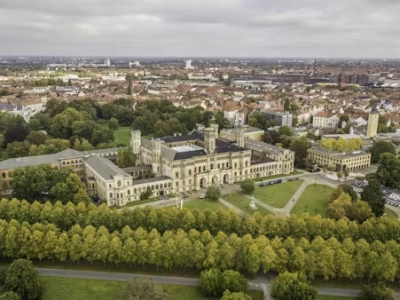
Europe has redefined its position in 2026 as a premier global education destination, blending centuries-old academic traditions with cutting-edge research and innovation. With over 29 countries accessible via a single Schengen visa, the continent offers international students an unparalleled multicultural experience and a diverse range of English-taught programs. The region's commitment to high-quality, subsidized education ensures that graduates are equipped with globally recognized degrees that carry immense prestige across international industries.
Quick Facts
- World-Ranked Institutions: 15+ Top 100
- Schengen Mobility: 29 Countries Accessible
- Work Authorization: 1–2 Year Permits
- Tuition Advantage: Low/Zero Public Fees

Why Choose Europe for Higher Education?
- Europe blends centuries of academic tradition with modern, globally top-ranked research facilities.
- The region offers thousands of accredited, high-quality programs taught entirely in English.
- Public universities in several nations provide world-class education with low or zero tuition fees.
- A single Schengen student visa grants seamless travel access across 29 European countries.
- The continent actively coordinates multi-country, fully funded scholarships like the Erasmus+ program.
- International graduates benefit from flexible post-study work permits lasting up to two years.
- Expanding job sectors in sustainability, AI, and healthcare welcome skilled global talent.
- Living and studying in Europe delivers an immersive, cross-cultural experience that enhances global perspectives.
Tuition and Living
In 2026, tuition ranges from €0–€4,000* at many public universities to €15,000*+ at private institutions. Monthly living costs vary by region, averaging €800–€1,200* in Southern/Eastern Europe and €1,300–€2,200* in major Western and Northern hubs. Fees shown are indicative only and may vary depending on the institution, course, study level, location, and intake. Please check the university or institution’s official website for the latest fees.
Careers & Industry Insights
The European labor market in 2026 is driven by critical skill shortages in the green economy, healthcare, and digital transformation sectors. Graduates benefit from robust post-study work pathways, such as the EU Blue Card and national “Orientation Year” visas, which facilitate long-term residency for those in STEM and high-demand roles. With the continent leading global initiatives in renewable energy and AI ethics, students gain exposure to future-proof industries with average starting salaries ranging from €45,000 to €75,000.
Popular Universities
ETH Zurich and the University of Amsterdam remain at the forefront of global research rankings for 2026. Other top-tier institutions including TU Munich, Sorbonne University, and KU Leuven are highly sought after for their academic rigor, specialized English-taught master’s tracks, and extensive industry partnerships.
Popular Universities in Europe

ETH Zurich

University of Amsterdam

Technical University of Munich

Sorbonne University

KU Leuven
Trending Courses
For the 2026 intake, Data Science, Artificial Intelligence, and Renewable Energy Engineering are the most trending programs due to high industry demand. Sustainability Management, Healthcare Informatics, and International Business also see record interest as students align their expertise with Europe’s strategic focus on a digital and green future.